

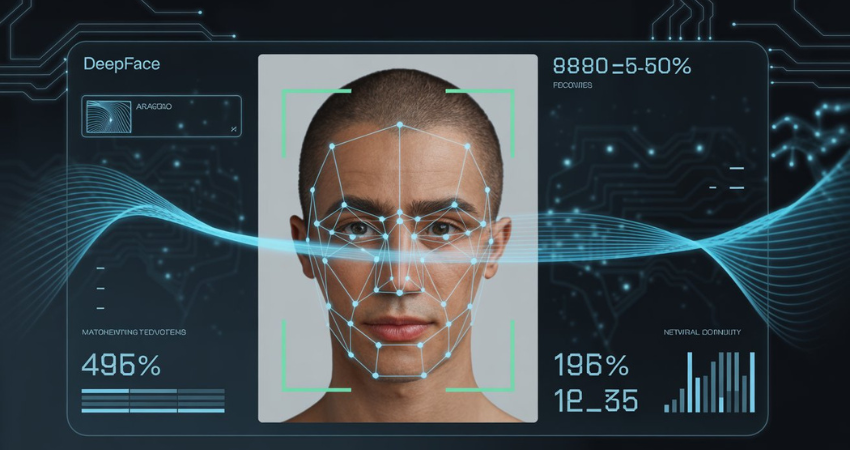
Facial recognition has always fascinated humans. From instantly recognizing a friend in a crowd to identifying a stranger from a blurry photograph, the human brain performs face recognition effortlessly. Deepface stepped into this space with one bold promise—to teach machines how to recognize faces almost as well as humans do. And surprisingly, it delivered.
Today, even though newer models have emerged, DeepFace remains a foundational milestone. It laid the groundwork for modern face recognition systems and pushed AI research forward. To truly understand where facial recognition stands today, we need to start with DeepFace and how it reshaped the landscape.
Understanding the Core Concept of DeepFace
At its heart, deepface is about teaching machines to see faces the way humans do. The word “Deep” in DeepFace refers to deep learning, a subset of machine learning that uses neural networks with many layers to process information. These layers allow the system to learn increasingly complex features—from basic edges and contours to full facial structures.
DeepFace works by mapping a face image into a mathematical representation, often called an embedding. Think of it like turning a face into a unique numerical fingerprint. Faces of the same person cluster closely together in this mathematical space, while faces of different people are far apart. Once this mapping is done, recognition becomes a simple comparison problem.
The Origins of DeepFace
DeepFace was developed by researchers at Facebook AI Research in 2014, at a time when deep learning was just beginning to dominate the AI landscape. Facebook faced a very practical problem: how to accurately identify people in billions of photos uploaded by users every day. Manual tagging was tedious, and existing face recognition systems simply weren’t good enough.
Instead of tweaking old methods, Facebook’s researchers took a bold leap. They combined deep neural networks with 3D face modeling to create a system that could understand faces at an unprecedented level. The goal wasn’t just incremental improvement—it was to reach human-level performance.
The results were groundbreaking. DeepFace achieved an accuracy of over 97% on the Labeled Faces in the Wild (LFW) benchmark, a standard test for facial recognition systems at the time. To put that into perspective, human accuracy on the same test was around 97.5%. For the first time, a machine was nearly as good as a human at recognizing faces.
How DeepFace Works: A Technical Overview
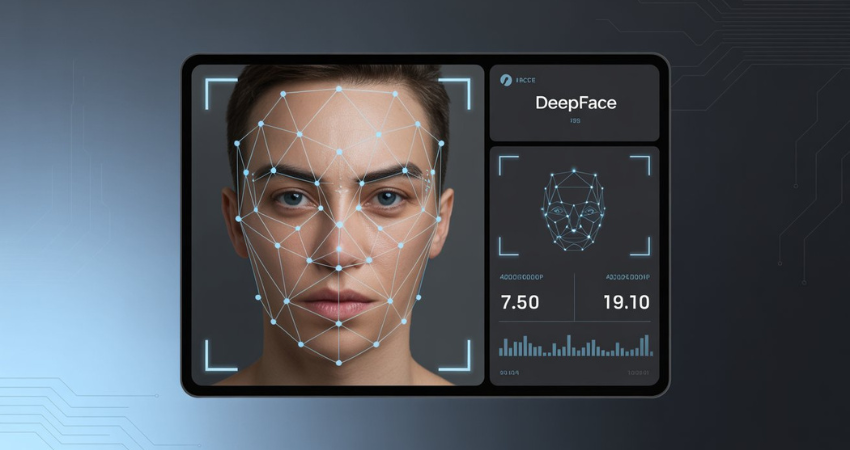
DeepFace doesn’t simply look at a face and make a guess. It follows a carefully designed pipeline that transforms raw images into reliable identity predictions. The first step is face detection. The system scans an image to locate faces, even in cluttered backgrounds. This step ensures that only relevant regions are processed further.
Next comes face alignment, one of DeepFace’s most innovative components. Using a 3D face model, the system aligns faces into a standardized position. Imagine rotating and adjusting a face so it looks straight at the camera, regardless of how the photo was taken. This alignment reduces variations caused by head tilt or camera angle.
What’s remarkable is how resilient this process is. Changes in hairstyle, facial hair, makeup, or lighting have minimal impact on the final representation. DeepFace focuses on stable facial features, much like humans do subconsciously. This robustness is what made it so effective in real-world applications.
The Deep Learning Architecture Behind DeepFace
The backbone of DeepFace is a deep convolutional neural network (CNN). CNNs are particularly well-suited for image processing because they analyze images in small patches, preserving spatial relationships. This allows the model to understand how different facial features relate to one another.
The architecture set a new standard for facial recognition systems. It demonstrated that combining deep learning with clever preprocessing could outperform traditional methods by a wide margin.
Accuracy and Performance of DeepFace
When DeepFace was introduced, its performance stunned researchers. Achieving over 97% accuracy on the LFW benchmark meant it was operating at near-human levels. This wasn’t a minor improvement—it was a leap forward.
What made this accuracy even more impressive was consistency. DeepFace performed well across different lighting conditions, facial expressions, and camera angles. It wasn’t just accurate in controlled environments but also in messy, real-world scenarios.
Before DeepFace entered the scene, facial recognition systems worked more like rigid rule-followers than intelligent observers. Traditional systems relied heavily on handcrafted features. Engineers explicitly told the algorithm what to measure—distances between eyes, angles of the jawline, width of the nose, or curvature of the lips. On paper, this sounded logical. In practice, it was painfully limited.
Another major difference lies in scalability. Older systems became inefficient and error-prone as databases grew larger. DeepFace, on the other hand, was designed with scale in mind. Its embedding-based approach allows quick and accurate comparisons, even across millions of identities.
In short, traditional systems tried to measure faces. DeepFace learned to understand them. That shift—from explicit programming to data-driven learning—is what made DeepFace a true breakthrough rather than just another incremental upgrade.
Applications of DeepFace in the Real World
DeepFace didn’t remain confined to research papers or laboratory experiments. Its real power emerged when it was applied to everyday problems across industries. Facial recognition suddenly became reliable enough to be trusted in real-world environments, and that opened countless doors.
DeepFace also found relevance in analytics. By recognizing individuals across different images or video frames, businesses could analyze behavior patterns, customer journeys, and engagement levels. While this raised ethical questions, it also demonstrated the versatility of the technology.
DeepFace in Social Media Platforms
Social media is where DeepFace truly made its presence felt. With billions of photos uploaded every day, manual photo tagging was never sustainable. DeepFace-powered systems introduced automatic face recognition and tagging, making photo organization almost effortless.
For users, this meant instant suggestions when tagging friends. Old memories resurfaced as platforms could recognize people across years of photos. From a user-experience perspective, it felt almost magical—like the platform truly “knew” who was in the picture.
DeepFace forced social media companies to confront these issues head-on. Opt-out options, transparency tools, and stricter policies emerged largely because of the capabilities DepFace introduced. In this way, it didn’t just change technology—it reshaped digital ethics and user expectations.
DeepFace in Security and Law Enforcement
Security is one of the most sensitive and controversial areas where DepFace-style technology has been applied. On one hand, accurate facial recognition can help identify suspects, locate missing persons, and enhance public safety. On the other hand, misuse can threaten civil liberties.
In controlled environments like airports or secure facilities, facial recognition offers a fast and contactless way to verify identity. Compared to ID cards or passwords, faces are harder to forge and easier to use. DepFace’s high accuracy made such applications feasible.
Future of DepFace Technology
While DepFace itself may no longer be the most advanced model, its influence is very much alive. Modern facial recognition systems build upon its principles, incorporating deeper networks, better data, and improved fairness measures.
Future systems are likely to integrate facial recognition with other biometric signals, such as voice or gait, creating multi-modal identification systems. Real-time recognition will become faster and more accurate, even on edge devices like smartphones.
At the same time, regulations will shape how this technology evolves. Privacy-preserving techniques, such as on-device processing and encrypted embeddings, are becoming more important.
DepFace showed what was possible. The future will determine how responsibly that power is used.
DeepFace vs Other Face Recognition Models
DepFace didn’t exist in isolation. It competed and coexisted with models like FaceNet, DeepID, and OpenFace. Each brought unique ideas to the table.
FaceNet popularized triplet loss for learning embeddings. DepID explored multi-layer supervision. OpenFace focused on open-source accessibility. DepFace stood out for its combination of deep learning and 3D alignment.
While newer models may outperform DepFace in raw accuracy, its conceptual contributions remain foundational. It was one of the first systems to prove that deep learning could rival human perception.
Limitations of DeepFace
Despite its strengths, DepFace has limitations. It requires significant computational resources and large datasets. It also struggles in extreme conditions, such as heavy occlusion or very low-quality images.
Legal and ethical constraints further limit its deployment. In many regions, facial recognition is heavily regulated or outright banned in certain contexts.
Understanding these limitations is crucial. DepFace is powerful, but it’s not magic.
How DeepFace Is Shaping the AI Industry
DepFace’s impact extends far beyond facial recognition. It helped validate deep learning as a practical solution for complex perception tasks. This success encouraged investment in AI research across industries.
Computer vision, once a niche field, became central to AI development. Autonomous vehicles, medical imaging, and augmented reality all benefited from the momentum DepFace helped create.
In many ways, DepFace didn’t just recognize faces—it helped the AI industry recognize its own potential.
Conclusion
Deepface represents a defining moment in artificial intelligence. It transformed facial recognition from a fragile, rule-based system into a robust, learning-driven technology capable of operating at near-human accuracy. Along the way, it sparked innovation, controversy, and deep ethical reflection.
Its legacy is not just technical but cultural. DepFace forced society to confront how powerful AI can be—and how carefully it must be handled. As facial recognition continues to evolve, the lessons learned from DepFace remain more relevant than ever.
FAQs
1. Is DeepFace still used today?
DepFace itself has largely been replaced by newer models, but its core ideas are still widely used.
2. How accurate is DepFace compared to humans?
DepFace achieved near-human accuracy, reaching over 97% on standard benchmarks.
3. Is DepFace open-source?
No, DeepFace was developed by Facebook and was not released as open-source software.
4. Can DepFace be used for surveillance?
Technically yes, but its use is often restricted by laws and ethical guidelines.
5. What makes DepFace different from other models?
Its combination of deep learning, massive data, and 3D face alignment set it apart.
